You Are Not a Museum: Letting Go of the Things That No Longer Carry You
Living as a minimalist is not, as it is so often caricatured, an aesthetic choice made by people who like white walls, bare shelves, and Scandinavian furniture catalogs. It is not about visual emptiness or performative restraint. It is, at its core, an act of confrontation. Minimalism forces a direct reckoning with memory, fear, identity, and the quiet bargains we strike with objects in order to avoid facing change.
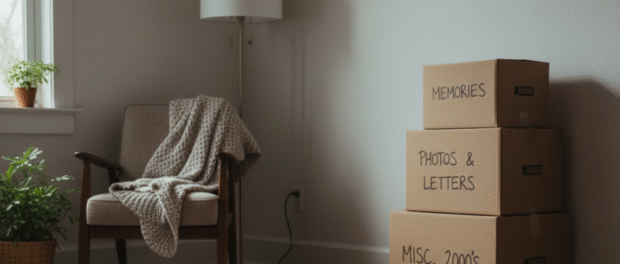
Most people do not hoard because they are careless. They hoard because they care too much, or rather, because they have been taught to care in the wrong way. Objects become proxies for experiences, relationships, aspirations, and former selves. A box of old letters is no longer paper. It is proof of being loved once. A cracked mug is not a vessel; it is a season of life made ceramic. A drawer full of obsolete electronics is not junk; it is the fossil record of ambition, productivity, and relevance. To discard these things feels less like cleaning and more like erasure.
Sentimentality thrives on confusion. We confuse memory with matter. We confuse continuity with accumulation. We confuse identity with evidence. And so we keep, not because the object serves us, but because we are afraid of what it would mean to no longer need it.
Minimalism challenges this confusion ruthlessly.
When you begin discarding the hoarded trinkets of the past, you are not simply throwing things away. You are dismantling a physical archive of emotional justifications. Every object asks a question: Who were you when you acquired this? Who did you think you would become? Why have you carried this forward, untouched, for years? And perhaps most uncomfortably: what are you postponing by keeping it?
This is why decluttering feels exhausting in a way that rearranging never does. Rearranging preserves the lie. Decluttering dissolves it.
There is a deep realism that must be acknowledged here: sentimentality is not foolish. It is human. Objects anchor memory because memory is fragile. We fear forgetting. We fear diminishing our own past by letting go of its artifacts. We fear that without the object, the meaning evaporates. But this fear misunderstands how memory actually works. Meaning does not reside in things. It resides in us. The object does not remember for you; it merely triggers what already lives in your mind. If a memory cannot survive without a physical prompt, it was already fading, and the object was never going to save it.
What hoarded possessions truly preserve is not memory, but indecision.
They represent choices never finalized, chapters never closed, identities never released. The guitar you never learned to play. The clothes that fit a body you no longer inhabit. The books you meant to read when life slowed down. Each item quietly asserts a claim on your future: “Someday.” Minimalism exposes the brutality of that word. Someday is not hope. It is delay disguised as optimism.
The limitations imposed by sentimental accumulation are subtle but profound. Space is the most obvious casualty. Physical clutter compresses living areas, but more importantly, it compresses possibility. A room filled with stored pasts has little capacity for present intention. Every shelf occupied by nostalgia is a shelf unavailable to now.
Time is the next casualty. Maintaining objects requires labor: cleaning, organizing, moving, repairing, worrying. Even untouched possessions demand attention simply by existing. They must be remembered, accounted for, justified. The more you own, the more mental energy is siphoned away from creativity, reflection, and action. This is not a moral failing; it is arithmetic. Attention is finite.
Mobility suffers as well. Accumulation roots you in place, whether you intend it or not. The more you own, the more you must defend your territory. You cannot leave easily. You cannot adapt quickly. Opportunities become negotiations with storage units, moving trucks, and sunk costs. The possessions meant to stabilize you instead immobilize you.
But perhaps the most insidious limitation is psychological. Hoarded objects maintain outdated narratives about who you are. They freeze former versions of yourself in amber and demand continued loyalty. Letting go feels like betrayal: of youth, of struggle, of past dreams. Yet clinging to these relics quietly undermines growth. You cannot fully become who you are now if your environment insists you remain who you were.
Minimalism does not demand emotional amnesia. It demands discernment.
To live minimally is to separate memory from material, meaning from mass. It is to honor experiences without embalming them. The realistic minimalist understands that some objects do earn their place. A few items may legitimately concentrate memory, function, and beauty into one presence. But these are rare. They reveal themselves clearly. Everything else survives by inertia.
Discarding trinkets is not an act of coldness. It is an act of trust. Trust that your life is not contained in boxes. Trust that your story does not require props. Trust that growth does not invalidate what came before.
There is grief in this process. Anyone who claims otherwise is either lying or numb. You will mourn versions of yourself that no longer exist. You will confront the finality of time. You will feel, briefly, unmoored. But what follows is not emptiness. It is clarity.
As possessions fall away, something unexpected happens: the present becomes louder. Your surroundings begin to reflect your current values rather than your accumulated fears. Decisions become easier. Movement becomes lighter. You stop negotiating with ghosts.
Minimalism, at its most honest, is not about having less. It is about being less encumbered by unresolved attachments. It is about choosing to carry memory internally rather than outsourcing it to objects that demand rent in space, time, and attention.
When you finally discard the hoarded trinkets of the past, you are not discarding your history. You are reclaiming authorship over it. You are saying, without apology, that your life is not a museum, and you are not a curator obligated to preserve every artifact of who you once were.
You are allowed to move forward unburdened. You are allowed to let things end. And you are allowed to discover that freedom is not found in what you keep, but in what you no longer need to carry.