
The Aesthetics of Polarity
There is a reason contrast arrests the eye.
Stand at the rim of the Grand Canyon at sunrise and watch shadow carve depth into stone. Without shadow, the canyon collapses into flatness. Without light, there is nothing to see. The beauty is not in one or the other. It is in the tension between them.
Polarity is not conflict. It is architecture.
We live in an age that fears difference. It tries to smooth edges, flatten gradients, and mute contrast. Everything must be blended, moderated, averaged. Yet the human nervous system is wired for contrast. We recognize form because something stands apart. We feel attraction because something is not us. We breathe in and out, not in and in.
A painting without contrast is lifeless. Consider the force in Caravaggio, whose use of chiaroscuro did not politely balance light and dark. He let darkness dominate whole canvases so that flesh and gesture would explode into visibility. The darkness was not an enemy. It was the frame that made light meaningful.
This is the aesthetic principle of polarity.
High and low. Soft and hard. Stillness and motion. Masculine and feminine. Silence and sound.
Even in music, tension and release shape our emotional response. Listen to the opening motif of Ludwig van Beethoven’s Fifth Symphony. Those four notes grip because they demand resolution. The power lies in the friction before harmony.
We instinctively understand this in art. We resist it in life.
Nature does not resist polarity. The magnetic field of Earth depends on opposing charges. The ocean tides respond to the gravitational pull of the Moon. The desert and the rainforest coexist on the same planet. Contrast is not an error in the system. It is the system.
When polarity is suppressed, energy stagnates. When it is exaggerated without awareness, it becomes destructive. The aesthetic lies in proportion, in clarity, in defined edges that do not dissolve into confusion.
This principle operates in the human body as well. The sympathetic and parasympathetic nervous systems function in counterbalance. One mobilizes. The other restores. Health is not the elimination of one in favor of the other. It is their rhythm.
The modern impulse toward sameness creates visual, cultural, and relational monotony. When everything is presented as interchangeable, desire weakens. When roles blur without intention, orientation fades. The eye cannot find a focal point. The psyche cannot find traction.

Polarity gives orientation.
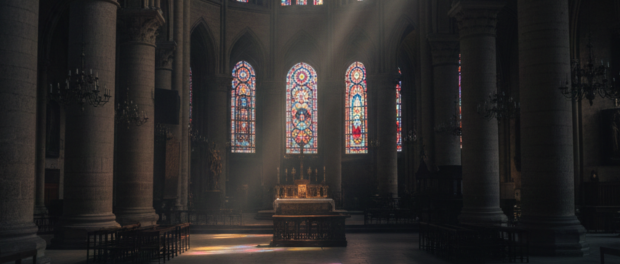
In architecture, a cathedral soars because its vertical thrust contrasts with the grounded weight of stone. Think of the nave of Notre-Dame de Paris. Stone columns anchor. Arches rise. Height intensifies solidity. Solidity magnifies height. The experience is not accidental. It is designed tension.
In the human aesthetic, polarity intensifies presence. Strength becomes more visible beside softness. Curvature becomes more pronounced beside angularity. Deep tone resonates differently when paired with lightness. Attraction is often less about similarity and more about complementary opposition.
This does not mean hostility. It does not require domination or erasure. It requires clarity.
Two magnets either repel or lock together depending on orientation. The force is not personal. It is structural.
The aesthetic of polarity invites us to stop apologizing for difference and to stop diluting intensity for the sake of comfort. It asks whether we have mistaken neutrality for harmony. True harmony is not beige. It is dynamic equilibrium.
Even the simplest visual composition obeys this law. A white canvas with a single black stroke carries more power than a canvas filled evenly with gray. The starkness commands attention because contrast awakens perception.
Consider the yin and yang symbol, not as mysticism but as design. Each contains the seed of the other. Each defines the boundary of the other. The curve between them creates motion. Static sameness would erase the form entirely.

In personal expression, polarity can manifest as disciplined structure paired with creative freedom. As independence balanced by intimacy. As silence that deepens speech.
When individuals embody a clear center, polarity does not threaten them. It enhances them. The clearer the edges, the stronger the interaction.
We are drawn to landscapes where mountains meet sky, where forest meets clearing, where land meets sea. The shoreline exists because two different elements refuse to merge into sameness. That boundary is one of the most beautiful places on Earth.
If you remove polarity from the equation, you remove depth. Without depth, there is no dimension. Without dimension, there is no immersion.
The aesthetics of polarity is not about exaggerating extremes for spectacle. It is about recognizing that contrast is the language of form. It is about allowing difference to sharpen perception rather than blur it.
Look again at the canyon at sunrise. Look at the cathedral vault. Listen to the unresolved chord before it resolves. Feel the inhale before the exhale.
Beauty lives in the space between forces that do not cancel each other out.
They define each other.
And in that definition, something vivid comes alive.